
A software development company in Bangalore that builds around your process.
Most companies do not set out to hire a software development company. They buy a tool, outgrow it, patch the gaps with spreadsheets, then pay someone to copy numbers between four systems that were never meant to talk to each other. Custom software development is what you commission when that arrangement starts costing more than it saves, in salary, in errors, and in decisions made two weeks late because nobody trusted the report.
- Custom software development, built around your process
- Software development outsourcing teams you can scale up or down
- Code, data and infrastructure owned by you from day one
- First usable release in eight to twelve weeks
No obligation. If it is not the right fit, we will say so plainly rather than pitch you.
We take on a limited number of new software builds each month to protect delivery quality.
Rated 4.5+ on Google · Trusted by FABCO Engineers, Usharo Media and Himavaan · Software development services delivered across India from Bangalore
Free consultation
Talk to a software development company in Bangalore today.
- Process first
- We map how the work runs before we design a screen
- Phased
- Launched in stages, not one high risk switchover
- Yours
- Code, infrastructure and data stay in your accounts
Brands we work with
Teams we run software development and more for.
In short
DG5 is a software development company in Bangalore delivering software development services across India, and we build the way a running business needs it built: around your real process, with your real data, launched in pieces rather than in one terrifying switchover. As an IT software development company we start by watching how work actually moves through your company today, including the informal parts nobody documented. The process on the org chart and the process that actually happens are rarely the same thing, and software written for the first one gets abandoned within a month.
02
Work we are happy to put our name on.
A small, real portfolio rather than a wall of borrowed logos. Websites, short form video and campaign design produced for clients who are still running the work today.
Fast, search ready websites built to be handed over in full, with the hosting, the analytics and the code in your name.
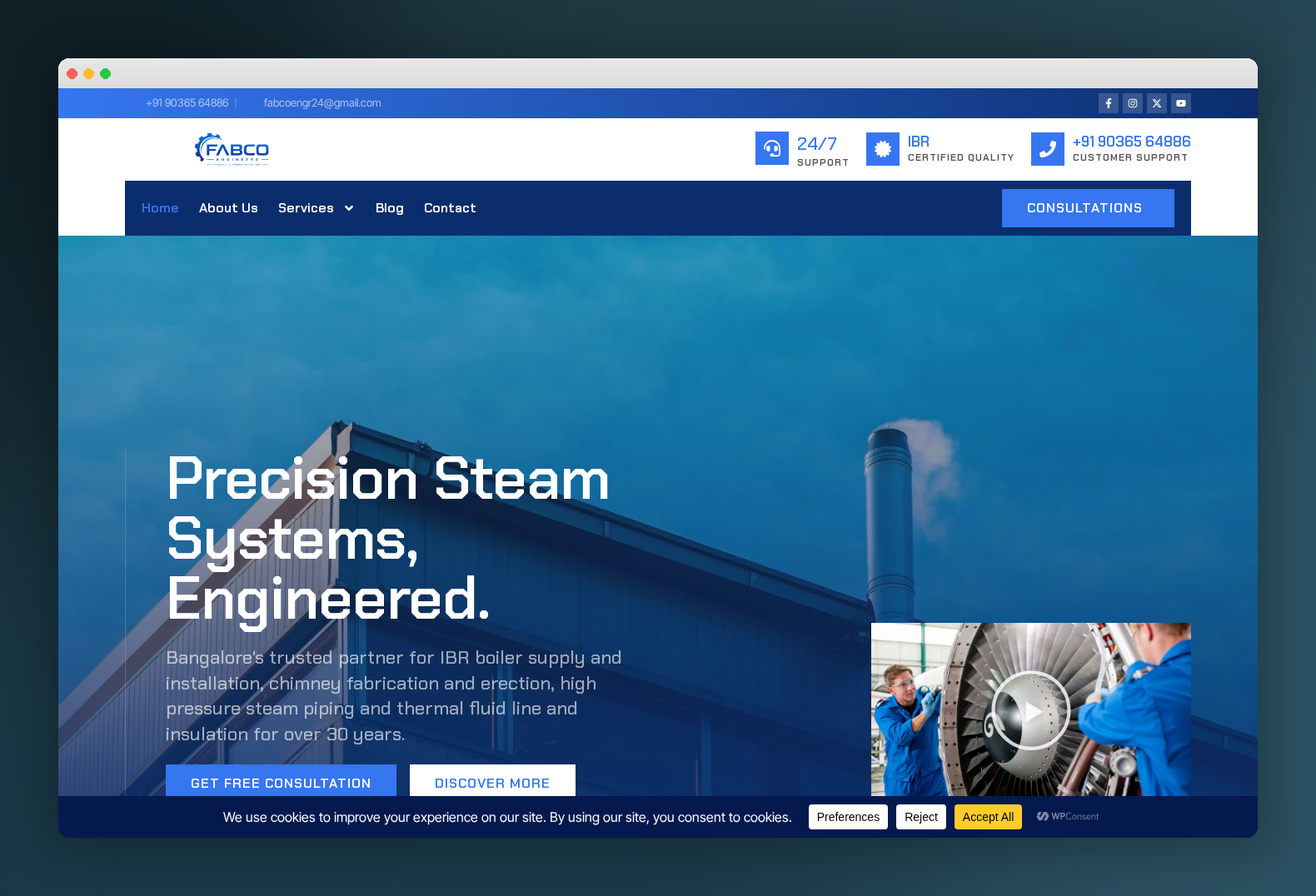
FABCO Engineers
Corporate site for an industrial engineering firm
Service architecture, enquiry funnel and technical SEO for a Bangalore boiler and fabrication specialist.
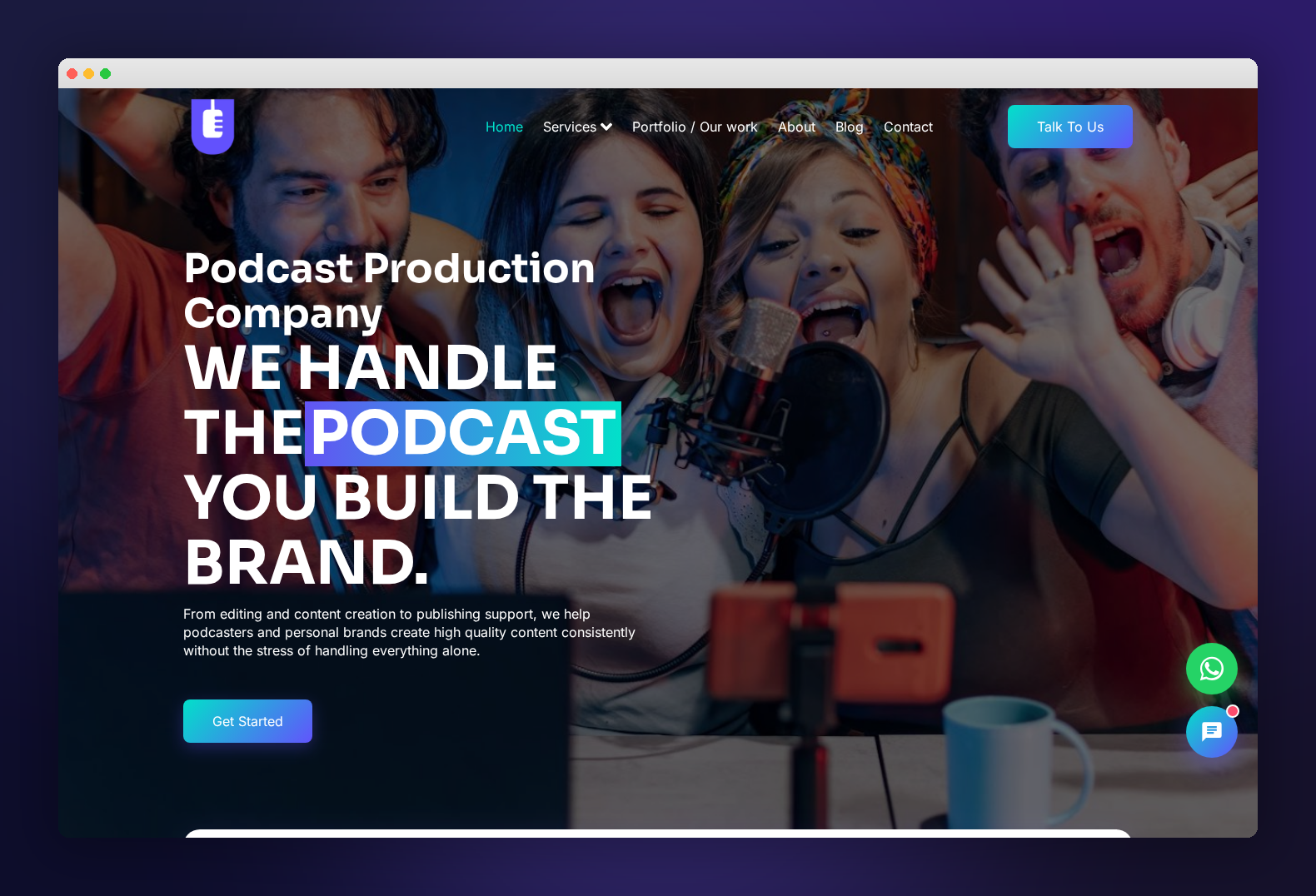
Usharo Media
Website for a podcast production studio
Positioning, portfolio structure and lead capture for a podcast and content production company.
What we build
Our software development services cover business systems that run an operation end to end: order and job management, inventory and stock movement, dispatch and logistics tracking, service ticketing, field team apps, approvals and audit trails. Customer facing products with accounts, subscriptions, billing and self service. Integration layers that finally connect your CRM, accounting software, payment gateway, warehouse system and marketing stack so a record entered once appears everywhere it is needed.
An IT software development company is also judged on the small things, and those quietly return the most time: an automation that generates and sends two hundred invoices instead of one person doing it every Friday, a reporting layer that pulls three systems into one dashboard leadership actually opens, a validation step that stops bad data entering at source rather than being cleaned up quarterly.
Where an off the shelf product genuinely covers the need, we will say so. Configuring an existing tool well is usually cheaper and faster than rebuilding features a subscription already provides. Any software development company can quote a build; we would rather scope custom software development honestly than sell you one you do not need.
- Business systems
- Order, inventory, job, ticketing and approval systems built around how your operation actually runs.
- SaaS and customer products
- Multi tenant products with accounts, roles, subscriptions, billing and self service onboarding.
- Integrations
- CRM, ERP, accounting, payments, logistics and marketing tools connected through a maintained API layer.
- Automation
- Scheduled jobs, document generation, notifications and data syncs that remove repetitive manual work.
- Reporting
- Operational dashboards built on a single source of truth rather than four exported spreadsheets.
How we work
Discovery comes first, and it is done sitting with the people who will use the software rather than only the people paying for it. This is the step most software development outsourcing arrangements skip, and skipping it is why so many builds land on a team that quietly goes back to the spreadsheet. We map the workflow as it exists, list the exceptions, identify where data enters and where it gets corrupted, and agree what the first release must do to be genuinely useful. Scope is deliberately trimmed here; a focused first version that ships beats a complete specification that takes a year.
Then architecture and the data model. Clients rarely see this part and it decides whether the system can grow. Entities, relationships, permissions, audit requirements and integration contracts are settled before interface design, because changing the model after screens are built is the fastest way to burn a custom software development budget.
Build runs in two week cycles with a working version available throughout. Your team uses each release against real tasks, which surfaces the gap between what was described in a meeting and what the job actually requires. Software development services that disappear for four months and return with a demo have no way of catching that gap before it is expensive.
Before launch: automated tests on the logic that matters, load testing against realistic volumes rather than a handful of clicks, a security review, and careful migration of existing data so nobody starts from an empty screen. Rollout is staged where the operation allows, one team or one branch at a time, with the old process available as a fallback until confidence is earned. Ask any IT software development company how it handles the week after go live, because that is the week that decides adoption.
- Discovery
- Workflow mapping with the people who do the work, including the exceptions and informal workarounds.
- Architecture
- Data model, roles, permissions and integration contracts agreed before any screen is designed.
- Delivery
- Two week cycles with a usable version throughout, tested by your team against real tasks.
- Launch
- Testing, security review, data migration and a staged rollout with a fallback path.
Built for the days it goes wrong
A demo shows software working when every input is clean and every user does the expected thing. Production shows what happens when a form is submitted twice, a payment gateway times out mid transaction, an integration partner changes an API without warning, a session expires halfway through a long entry, or two people edit the same record at once. At volume these are not rare events, they are Tuesday, and they separate a serious software development company from a cheap quote.
So we design for them deliberately: idempotent operations so a repeated request does not create a duplicate order, retries and dead letter handling on integrations, clear conflict resolution on concurrent edits, and error states written in language a user can act on instead of a stack trace. Every important action leaves an audit record, because in an operational system the question is rarely what the data says now and usually who changed it and when.
Monitoring and alerting are set up before launch, not after the first outage. If a nightly sync fails at 2am, someone should know at 2:05am rather than when a customer calls at noon. That is the unglamorous half of software development services and the half clients remember.
Security, data and ownership
Permissions are enforced on the server, not merely hidden in the interface, because a hidden button is not a security control. Roles are defined from the data model up, input is validated at every boundary, and sensitive fields are handled with encryption and restricted access rather than being visible to anyone with a login. An IT software development company that treats security as a launch week task is choosing your risk for you, and those problems are rarely easy to unwind later.
Backups are automated and, more importantly, restore is tested. A backup nobody has ever restored is a hope, not a plan. Where your sector carries obligations around data residency, retention or consent, those constraints are written into the architecture at the start rather than retrofitted under pressure later, and they are part of what the quote covers rather than an extra line item.
Ownership is not negotiable and never leveraged. The repository, hosting, databases and documentation sit in your accounts from day one. Handover is written so an internal hire or another software development company could take the system forward without us, which is the only honest definition of a completed project.
- Server enforced roles
- Permissions checked on the backend, with the interface reflecting them rather than defining them.
- Audit trails
- Who changed what, when, recorded on the actions where it matters.
- Tested restores
- Automated backups with a restore procedure that has actually been run.
- Full ownership
- Repository, infrastructure, data and documentation in your accounts from the first commit.
Who this work suits
Operations running a critical process on spreadsheets, WhatsApp threads or a tool bought when the company was a third of its current size. Businesses whose systems do not talk to each other, where the same order is keyed into three places and the numbers still disagree at month end. Teams launching a product that needs accounts, billing and usage tracking rather than a marketing site with a contact form. Those are the situations where a custom build pays for itself fastest.
Software development outsourcing suits a second group: companies with a product roadmap and no capacity to hire and retain engineers for it in Bangalore's market, where every software development company is chasing the same shortlist. In that model our software development services act as your delivery team, working to your priorities, with your code in your repository.
It is a weaker fit when an existing subscription covers the requirement at a fraction of the cost, when the process is still changing weekly and has not settled enough to encode, or when the real problem is that nobody owns the process rather than that the software is missing. No IT software development company can fix that with code. Software makes a good process faster and a broken process faster at breaking.
If what you actually need is a customer facing application in the browser rather than an internal operational system, our web application development service is the closer fit, and if the requirement is a marketing site with a content editor, website development is where to start.
- Best fit
- Settled processes outgrowing spreadsheets, disconnected systems, and products needing accounts and billing.
- Outsourcing fit
- A roadmap and no hiring capacity, where an external delivery team ships against your priorities.
- Weak fit
- Needs covered by an existing subscription, or processes still changing too fast to encode.
After launch
Software is not finished at launch, it is finished when it is retired. Real usage always surfaces what a test environment did not: an edge case nobody mentioned, a report leadership now wants weekly, a partner API that changes, a volume spike that exposes a slow query. Building software is a relationship with a system, not a delivery date.
Most clients continue on a support arrangement covering monitoring, fixes, dependency and security updates, and a monthly allowance for refinements and new features. For teams already using us as their IT software development company this is simply the same team continuing at a lower cadence, which keeps the system improving in step with the business rather than decaying into the legacy tool a future project has to replace.
Training and documentation are part of delivery, not an afterthought. A short recorded walkthrough per role, written documentation for admins, and a clear escalation path mean the system survives the departure of whoever championed it internally. Software development services that end at handover leave that risk with you.
Industries we build for
Every software development company claims it can build for any industry. What matters is whether the team has sat with the people whose work the software has to carry, in conditions specific to that sector: a factory floor with patchy connectivity, a media house shipping content on daily deadlines, a hospitality business whose demand doubles in season. Our custom software development work so far sits in industrial and manufacturing with FABCO Engineers, media and content platforms with Usharo Media, and travel and hospitality with Himavaan, and those engagements shape how we scope everything else.
The cards below are an honest picture of where our custom software development experience runs deepest, followed by sectors where the problems we already solve transfer directly even when the industry does not. We deliver software development services across India and take on software development outsourcing for teams well outside Bangalore, so if your sector is not listed, ask. The useful question is never whether we have your exact industry on a slide, it is whether we have built for the same kind of process, data and constraints.
- Industrial and manufacturing
- Our work with FABCO Engineers covers engineering led manufacturing, where drawings, quotations, revisions and site work pass through many hands. Systems here live or die on traceability: which version went to the customer, who approved it, and what was actually delivered.
- Media and content
- With Usharo Media we work where deadlines are daily and assets multiply fast. Content platforms, production pipelines, client approvals and delivery tracking, built so nothing important lives in one person's inbox.
- Travel and hospitality
- Our work with Himavaan sits in travel and hospitality, where availability, seasonal pricing and guest communication decide revenue. Systems in this sector need to stay correct at peak season, not just on a quiet Tuesday.
- Retail and ecommerce
- Catalogue operations, inventory that stays in sync across your own store and marketplaces, and order flows that do not need manual reconciliation at month end. Most retail software projects we see are really data consistency projects wearing a costume.
- Healthcare and clinics
- Appointment flows, patient records handled with the consent and privacy constraints the sector demands, and reporting administrators can trust. Data sensitivity and audit requirements are designed in from the start, never bolted on later.
- Logistics and field operations
- Dispatch planning, shipment tracking and field team apps built for people working on the move, where connectivity drops, the software still records what happened and syncs later, and no entry is ever lost.
Our technology approach
We do not sell a proprietary stack, because a stack is not a product and lock in is not a feature. Technology choices follow the same order on every project: your existing systems first, your team's ability to maintain what ships second, our preferences last. A client already running on Microsoft tooling should not be migrated onto something fashionable because the agency knows it better. This is the least glamorous part of our software development services and the one with the longest consequences.
As an IT software development company working across web, mobile and backend systems, we work daily with TypeScript, React and Node.js, with Flutter and React Native where a mobile app makes sense, with PostgreSQL and similar databases where relational integrity matters, and with the major cloud platforms for hosting, storage and background jobs. Treat that as examples, not a menu you must order from. The right answer is frequently the boring one: the database your team can query, the framework your next hire will already know, the hosting your finance team can forecast.
It is also why our software development outsourcing model looks the way it does. If you are comparing partners, ask each software development company the same two questions: who owns the repository, and what happens to the system if the relationship ends. With us the answers are you, and nothing changes, because the code, infrastructure, data and documentation sit in your accounts from the first commit and handover is written so another team can pick it up without us in the room.
- Frontend
- React and TypeScript for interfaces that stay maintainable over years, with permissions enforced on the server behind every screen.
- Backend and APIs
- Node.js and comparable runtime friendly services, with integration contracts documented so any third party can be swapped without a rebuild.
- Mobile
- Flutter or React Native when one codebase across iOS and Android is the right trade, native development when it is not.
- Data and cloud
- PostgreSQL and comparable databases on established cloud platforms, with automated backups and a restore procedure that has actually been run.
- No lock in
- No proprietary frameworks, no rented runtime, no hostage data. Everything we build with is something another competent software development company could take over.
What is included
Deliverables, spelled out.
Scope is agreed in writing before we start, so there is never a debate later about whether something was part of the engagement.
- 01Workflow discovery and process mapping with end users
- 02Data model, roles and permissions architecture
- 03Interface design covering every state, including errors and empty data
- 04Front end and back end development in two week cycles
- 05Integrations with CRM, accounting, payments and existing systems
- 06Automated tests, load testing and security review
- 07Data migration from spreadsheets or legacy systems
- 08Monitoring, alerting and tested backup and restore
- 09Documentation, role based training and handover
- 10Ongoing support, updates and software development outsourcing capacity
What makes DG5 different from a typical Software development agency.
How our Software development delivery model compares to two common alternatives businesses evaluate. Typical industry norms, not any specific competitor, so you can benchmark on capability and transparency rather than marketing claims.
Capability
DG5 Agency
Boutique agency
Large network agency
Strategy depth
DG5:End to end funnel strategy
Boutique:Strong in one niche
Network:Templated playbook
Team on your account
DG5:The strategist who scoped it stays on it
Boutique:Founder plus a small team
Network:Rotating account managers
Reporting
DG5:Live dashboard tied to leads and revenue
Boutique:Monthly call and deck
Network:PDF only
Scope
DG5:Web, SEO, ads and automation together
Boutique:One or two channels
Network:Separate channel silos
Turnaround
DG5:Weekly shipping cadence
Boutique:Fast but capacity limited
Network:Queued behind bigger retainers
When something fails
DG5:Flagged with the reason and the fix
Boutique:Depends on the founder
Network:Quietly dropped from the report
Contract
DG5:Flexible terms, earned monthly
Boutique:Flexible but informal
Network:Long lock ins
This comparison reflects our own delivery model and common evaluation criteria clients use when comparing agencies in Bangalore, not a claim about any specific competitor.
What clients say about working with us.
"DG5 rebuilt our site and aligned our SEO and paid lead generation around the product categories that actually drive enquiries. The leads that come in now already understand what we do before the first call."
"The travel content and video work DG5 produces feels like our own voice, just louder. Their reels and campaign posters have directly filled departure slots we would otherwise have struggled to close."

"DG5 runs our social channels, paid campaigns and website updates as one rhythm. The best part is the reporting: we know which post, which ad and which landing page moved the needle."
How the work runs.
Map and scope
Sit with the people doing the work, map the real process and its exceptions, and trim the first release of your custom software development to what is genuinely useful.
Model and build
Settle the data model, roles and integrations, then build in two week cycles with a working version your team tests throughout, whether we are building for you or running software development outsourcing alongside your own team.
Launch and support
Testing, security review, data migration and a staged rollout, followed by monitoring, training and ongoing software development services.
What clients ask before signing.
What does it cost?
+
Cost tracks scope, integration count and data complexity more than screen count. After discovery we give a phased estimate so you can see what the first usable release costs separately from later phases, and you can stop, pause or reprioritise between phases.
How long does a custom software project take?
+
A focused internal system typically reaches a usable first release in eight to twelve weeks. Larger operational platforms or customer facing products with billing and integrations usually run four to six months. We size the timeline after discovery rather than quoting before the data model and integrations are understood.
How is custom software different from buying an off the shelf tool?
+
An off the shelf tool asks your process to fit its assumptions, which is fine when the assumptions match. Custom software fits your process, connects to the systems you already run, and has no per seat cost that grows with your team. We recommend the off the shelf route whenever it genuinely covers the need, because it is usually cheaper and faster.
Can you work with our existing systems and data?
+
Yes. Integrating with existing CRMs, ERPs, accounting software, payment gateways and databases is standard, and migrating historic data from spreadsheets or legacy systems is planned as part of launch rather than left to your team.
Do we have to switch everything over on one day?
+
No, and we would advise against it. Where the operation allows, we roll out by team, branch or module with the old process available as a fallback until the new system has earned trust.
Who owns the code and the data?
+
You do, from the first commit. The repository, hosting, databases and documentation sit in your accounts, and handover is written so an internal team or another developer could continue without us.
What happens if our requirements change mid project?
+
They usually do, which is why we work in two week cycles with a live version throughout. Changes are re prioritised against the remaining scope openly, so you see the trade off in time and cost before agreeing to it rather than after.
Do you provide support after launch?
+
Yes. Most clients take an ongoing arrangement covering monitoring, fixes, security and dependency updates, and a monthly allowance for refinements, since real usage reliably surfaces things a test environment did not.
Related services
Website development
Fast, search ready websites built to convert. DG5 designs and builds responsive sites in Bangalore with page speed, accessibility and lead capture handled from the first wireframe.
Ecommerce development
Online stores built to sell: Shopify, WooCommerce and custom stacks tuned for page speed, catalogue clarity, checkout completion and repeat purchase.
Web application development
Custom web applications built for real workflows, dashboards, portals, internal tools and customer facing platforms. DG5 designs and builds web apps that hold up under actual daily use.
This month only
Start software development. Get 1 month of social media management free.
Content, posting and reporting for your channels, run by our social team at no cost for the first month of any engagement.
Last step
Get a free consultation with our software development team.
Leave a name and a number. We will call, understand the process you are trying to fix, and tell you honestly whether custom software development is the right answer for it. It is a conversation, not a pitch from a software development company with a template quote.
No obligation. If it is not the right fit, we will say so plainly rather than pitch you.
We take on a limited number of new software builds each month to protect delivery quality.
Tell us what you are trying to grow.
Send us the context, the product, the market, what has already been tried. You will get a straight answer about whether we can help and what it would take, usually within one working day.
+91 78999 13338 · hello@dg5agency.com