
Software for the work you actually do.
A website tells people about the business. A web application lets people do something inside it, book a slot, track an order, manage inventory, log in and see something specific to them. That difference sounds small until you try to bolt a login system and a dashboard onto a site that was built to be a brochure, at which point the difference becomes every future headache you will have.
- Role based
- Access built in from the data model up
- API first
- Built to connect with the tools you already run
- Owned
- Code, infrastructure and data stay in your accounts
Brands we work with
Teams we run web application development and more for.
In short
We build these as applications from the first sketch, with a data model, user roles, states for empty and error and loading, and a plan for what happens when two hundred people use it at once instead of five people testing it in a browser tab. That discipline is what separates a tool your team will actually rely on from one that gets quietly abandoned after launch.
02
Work we are happy to put our name on.
A small, real portfolio rather than a wall of borrowed logos. Websites, short form video and campaign design produced for clients who are still running the work today.
Fast, search ready websites built to be handed over in full, with the hosting, the analytics and the code in your name.
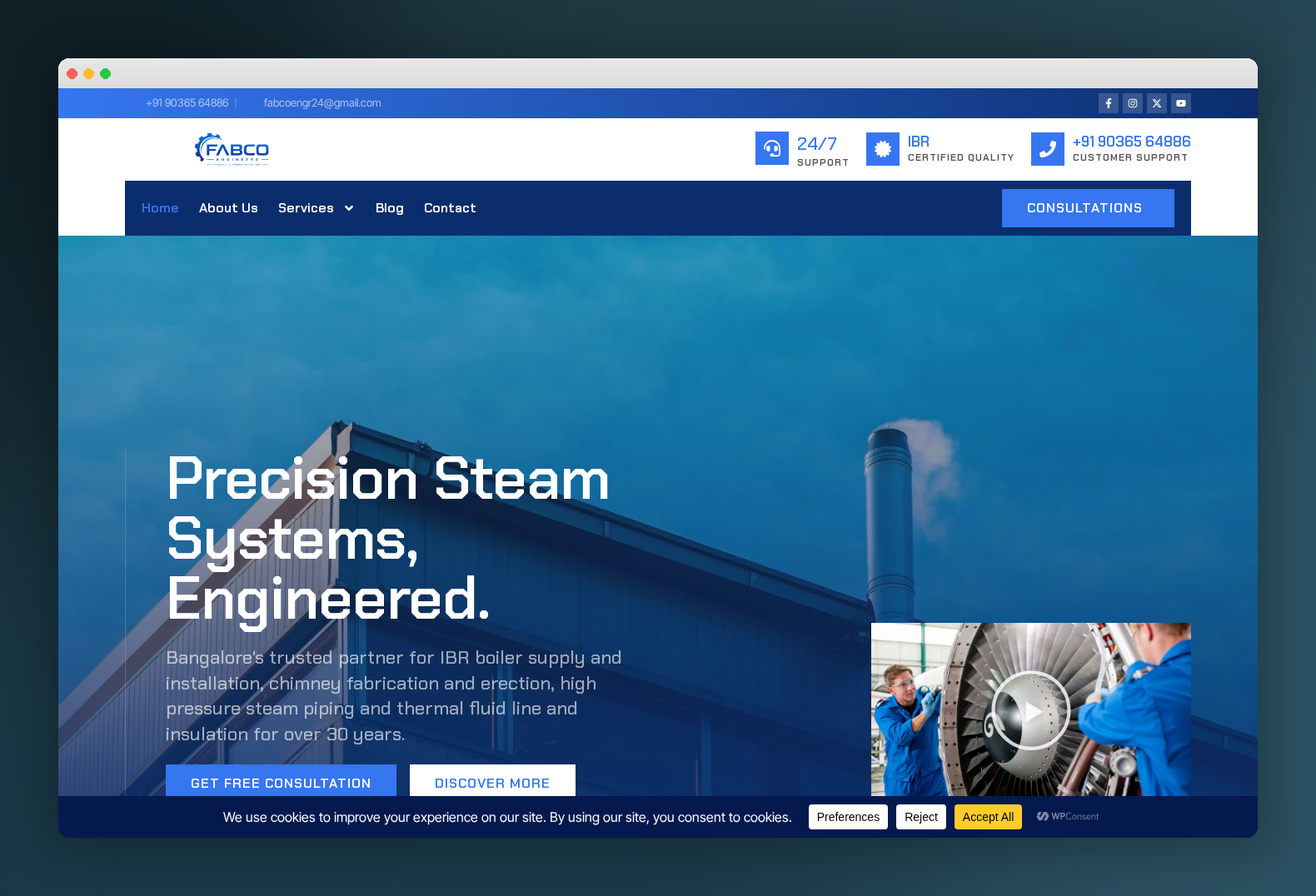
FABCO Engineers
Corporate site for an industrial engineering firm
Service architecture, enquiry funnel and technical SEO for a Bangalore boiler and fabrication specialist.
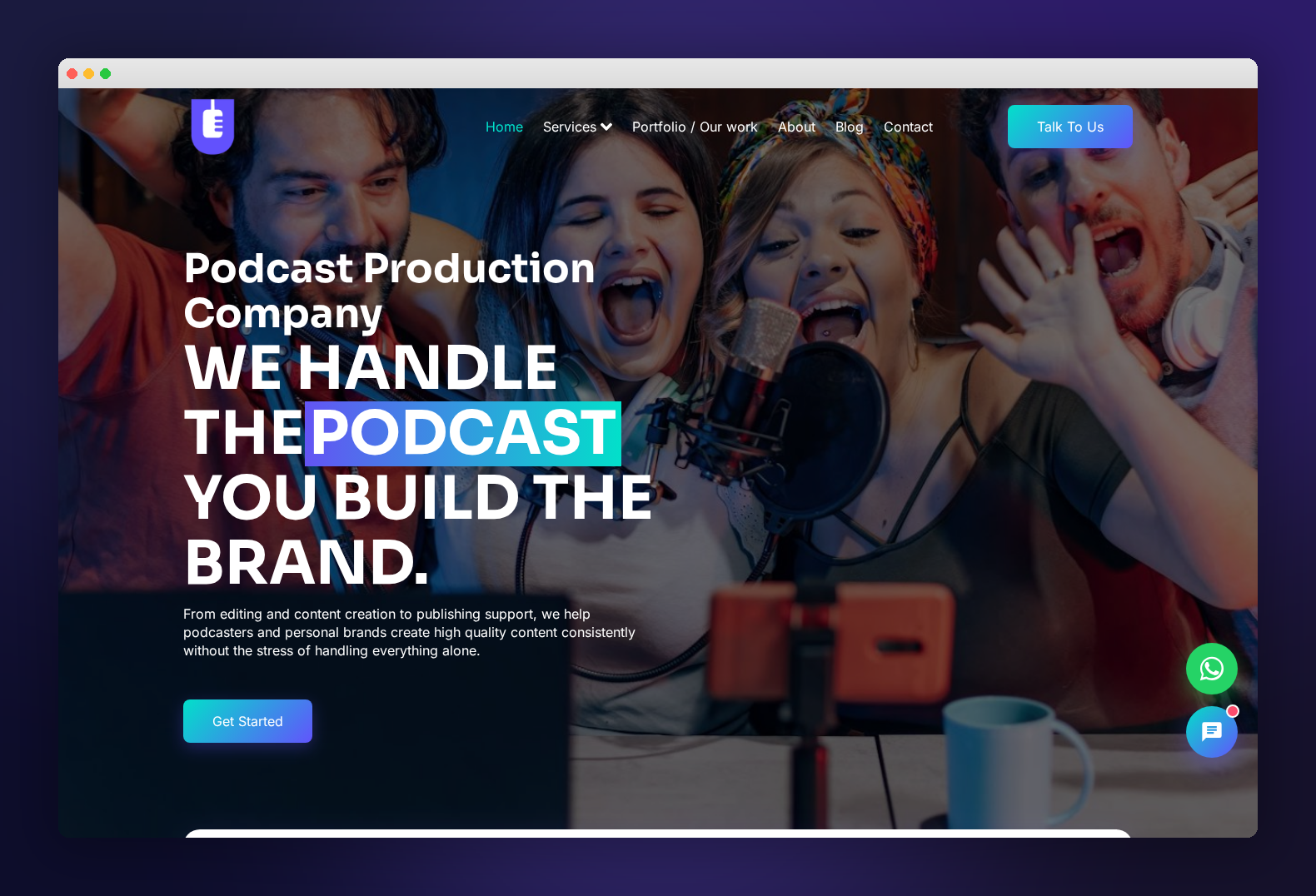
Usharo Media
Website for a podcast production studio
Positioning, portfolio structure and lead capture for a podcast and content production company.
What we build
Customer portals, booking and scheduling systems, internal dashboards, inventory and order management tools, membership and subscription platforms, and bespoke tools that replace a spreadsheet three people are currently fighting over. Some of these sit behind a login for your team, some are customer facing, and many are both, an internal admin view and a customer facing self service view over the same data.
We choose the technical stack based on what the application actually needs to do and who will maintain it afterwards, not on trend. A straightforward internal tool with modest traffic does not need the same architecture as a customer facing platform expecting thousands of concurrent users, and pretending otherwise is how projects overrun their budget for no functional gain.
Every build starts from the data model and the user roles, because those decisions are expensive to change later and cheap to get right early. Screens come after the model is settled, not before.
- Discovery and data modelling
- User roles, permissions, core entities and workflows mapped before any screen is designed.
- Design
- Interface design covering every state, empty, loading, error and success, not just the happy path shown in a pitch deck.
- Build
- Front end and back end development with authentication, role based access and an API layer built to extend.
- Integration
- Connections to payment gateways, CRMs, existing databases and third party services your business already runs on.
Built for the edge cases, not just the demo
A demo shows the application working when everything goes right. Real use shows what happens when a form is submitted twice, a payment fails halfway through, a user's session expires mid task, or two people edit the same record at once. We design and test for these deliberately, because this is where most poorly built applications actually fall apart in production.
Performance under real load matters as much as it does for a marketing site, arguably more, since an application that is slow to save a record or load a dashboard costs your team working hours every single day rather than costing you a bounced visitor once. We load test before launch against realistic usage patterns, not just a handful of manual clicks.
Security is treated as a first class requirement rather than a checklist at the end: proper authentication, role based permissions enforced on the server rather than only hidden in the interface, input validation, and secure handling of any sensitive data the application touches.
Where this differs from a website build
A website is mostly read by visitors and occasionally updated by your team through a content editor. An application is written to constantly, by many users, often with different permissions, and the data it holds usually needs to be correct, auditable and backed up properly, because it is not just marketing copy anymore, it may be orders, records or money.
That shifts the priorities. Search engine visibility matters much less for an internal tool than uptime, data integrity and how quickly your team can be trained to use it. For a customer facing application, both matter, findability to bring people in and reliability once they are inside.
If your need is closer to a marketing site with a content editor, our website development service is the better starting point, and we will say so rather than scoping an application build you do not need.
Who this work suits
Teams currently running a critical part of the business on spreadsheets, WhatsApp threads or a tool that was never designed for the volume it now handles. Businesses launching a product that requires customer accounts, bookings or ongoing usage tracking. Companies who have outgrown an off the shelf SaaS tool that almost fits but forces awkward workarounds every week.
It is a weaker fit if an existing off the shelf tool genuinely covers the need. We would rather configure something that already exists well than build a custom application to replicate features a subscription already provides at a fraction of the cost.
- Best fit
- Workflows outgrowing spreadsheets, customer facing tools requiring accounts, and gaps no off the shelf SaaS fills well.
- Weak fit
- Needs already well served by an existing subscription tool at lower cost than a custom build.
How a project runs
Discovery maps the users, their roles, the core workflows and the data involved, usually over one to two weeks depending on complexity. We agree the data model and a rough architecture before any interface design begins, because reworking the model after screens are built is the single most common source of budget overrun on application projects.
Build happens in sprints with a working, testable version available throughout rather than a single reveal at the end. Your team tests real workflows as features land, so issues surface while they are still cheap to fix.
Before launch we run load testing, security review and a staged rollout where possible, migrating existing data carefully rather than asking users to start from zero. After launch we typically stay on for a support period covering fixes, small refinements and monitoring, since real usage always surfaces things a test environment did not.
What is included
Deliverables, spelled out.
Scope is agreed in writing before we start, so there is never a debate later about whether something was part of the engagement.
- 01Discovery, user role and data model mapping
- 02Interface design covering every application state
- 03Front end and back end development
- 04Authentication and role based access control
- 05API layer and third party integrations
- 06Load testing and security review before launch
- 07Data migration from existing systems or spreadsheets
- 08Documentation, training and post launch support
What makes DG5 different from a typical Web application development agency.
How our Web application development delivery model compares to two common alternatives businesses evaluate. Typical industry norms, not any specific competitor, so you can benchmark on capability and transparency rather than marketing claims.
Capability
DG5 Agency
Boutique agency
Large network agency
Strategy depth
DG5:End to end funnel strategy
Boutique:Strong in one niche
Network:Templated playbook
Team on your account
DG5:The strategist who scoped it stays on it
Boutique:Founder plus a small team
Network:Rotating account managers
Reporting
DG5:Live dashboard tied to leads and revenue
Boutique:Monthly call and deck
Network:PDF only
Scope
DG5:Web, SEO, ads and automation together
Boutique:One or two channels
Network:Separate channel silos
Turnaround
DG5:Weekly shipping cadence
Boutique:Fast but capacity limited
Network:Queued behind bigger retainers
When something fails
DG5:Flagged with the reason and the fix
Boutique:Depends on the founder
Network:Quietly dropped from the report
Contract
DG5:Flexible terms, earned monthly
Boutique:Flexible but informal
Network:Long lock ins
This comparison reflects our own delivery model and common evaluation criteria clients use when comparing agencies in Bangalore, not a claim about any specific competitor.
What clients say about working with us.

"DG5 rebuilt our site and aligned our SEO and paid lead generation around the product categories that actually drive enquiries. The leads that come in now already understand what we do before the first call."
"The travel content and video work DG5 produces feels like our own voice, just louder. Their reels and campaign posters have directly filled departure slots we would otherwise have struggled to close."

"DG5 runs our social channels, paid campaigns and website updates as one rhythm. The best part is the reporting: we know which post, which ad and which landing page moved the needle."
How the work runs.
Discover and model
Map users, roles, workflows and the data structure the application will run on before any screen is designed.
Design and build
Interface design for every state, then development in sprints with a working version available throughout.
Test and launch
Load testing, security review, careful data migration and a staged rollout, followed by a support period.
What clients ask before signing.
How is a web application different from a website?
+
A website is mostly read by visitors and updated occasionally through a content editor. An application is written to constantly by many users with different permissions, and usually holds data that needs to be accurate, secure and backed up, orders, records or accounts rather than marketing copy.
How long does a custom application take to build?
+
A focused internal tool can launch in six to ten weeks. Customer facing platforms with accounts, payments and integrations typically run three to six months depending on scope. We size the timeline after discovery rather than quoting before the data model is understood.
Can you integrate with the tools we already use?
+
Yes, integration with existing CRMs, payment gateways, databases and third party services is a standard part of scoping, and we build the API layer to support it from the start rather than retrofitting it later.
What happens if our usage grows significantly after launch?
+
We architect and load test against realistic future usage, not just launch day traffic, and the infrastructure choices are made so the application can scale without a full rebuild.
Do you build mobile apps as well?
+
Our focus is web applications, which run in the browser on both desktop and mobile and often cover the same need as a native app at lower cost and faster iteration. Where a genuine native app is required, we can advise on that scope separately.
Who owns the code and infrastructure after launch?
+
You do. Repository, hosting, databases and all documentation sit in your accounts from day one, and the handover is built so an internal team or another developer could take over without our involvement.
Do you offer ongoing support after launch?
+
Yes, most clients take a support period or an ongoing retainer covering fixes, monitoring and small feature additions, since real usage reliably surfaces things a pre launch test environment does not.
Related services
Website development
Fast, search ready websites built to convert. DG5 designs and builds responsive sites in Bangalore with page speed, accessibility and lead capture handled from the first wireframe.
SEO
SEO that earns qualified traffic: technical audits, keyword and intent mapping, on page work, local search and content that answers real buying questions. Bangalore based, working across India.
Ecommerce development
Online stores built to sell: Shopify, WooCommerce and custom stacks tuned for page speed, catalogue clarity, checkout completion and repeat purchase.
This month only
Start web application development. Get 1 month of social media management free.
Content, posting and reporting for your channels, run by our social team at no cost for the first month of any engagement.
Tell us what you are trying to grow.
Send us the context, the product, the market, what has already been tried. You will get a straight answer about whether we can help and what it would take, usually within one working day.
+91 78999 13338 · hello@dg5agency.com