
Websites built to be found, read and acted on.
Most business websites are not slow because nobody cared. They are slow because they were assembled over four years by three different vendors, each of whom added a slider, a chat widget and a tracking script without removing anything. The result loads in nine seconds on a mid range Android phone on a patchy 4G connection in Whitefield, which is exactly how a large share of your audience will meet you.
- < 2s
- Target load on 4G mobile
- 90+
- Lighthouse performance target
- 0
- Page builder bloat carried over
Brands we work with
Teams we run website development and more for.
In short
We build websites the other way round. Structure first, content second, decoration only where it earns its weight. Every page has a job, rank for something specific, answer a specific objection, or capture a specific enquiry, and if a section cannot name its job, it does not ship.
02
Work we are happy to put our name on.
A small, real portfolio rather than a wall of borrowed logos. Websites, short form video and campaign design produced for clients who are still running the work today.
Fast, search ready websites built to be handed over in full, with the hosting, the analytics and the code in your name.
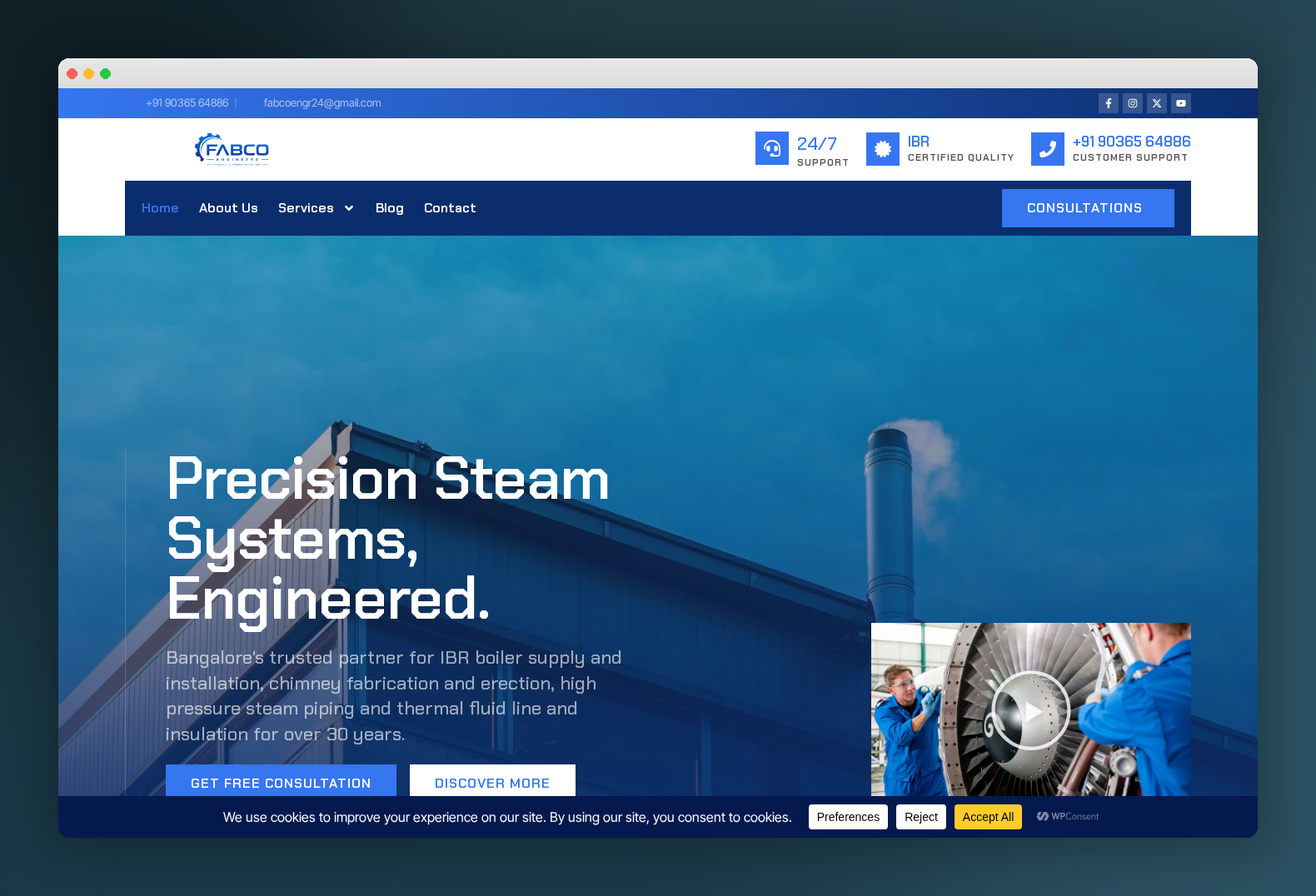
FABCO Engineers
Corporate site for an industrial engineering firm
Service architecture, enquiry funnel and technical SEO for a Bangalore boiler and fabrication specialist.
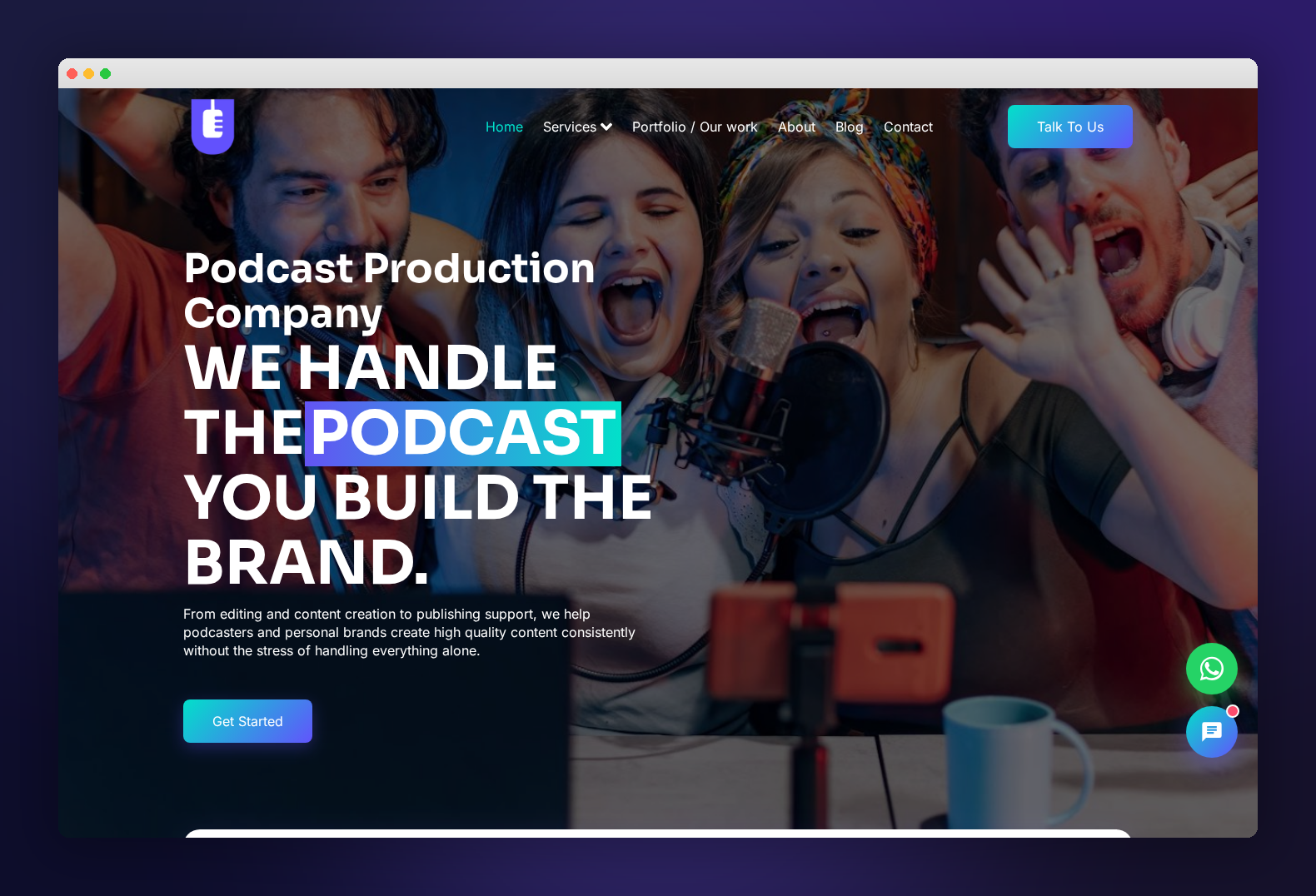
Usharo Media
Website for a podcast production studio
Positioning, portfolio structure and lead capture for a podcast and content production company.
What we actually build
Marketing sites, service business sites, multi location sites, landing page systems and content hubs. Sometimes that means a hand built front end on a modern stack; sometimes it means a well configured WordPress or Webflow install because your marketing team needs to publish twice a week without raising a ticket. The choice follows the team who will use it, not our preferences.
We start by mapping the site as a set of URLs rather than a set of screens. That mapping decides what ranks, what gets shared, what gets linked to and what can be updated independently. A site planned this way tends to grow cleanly for years; a site planned as a series of Figma frames usually needs rebuilding the moment a new service line appears.
Design happens in the browser as much as in the design tool. Type scale, line length and vertical rhythm are decided against real copy, not lorem ipsum, because a heading that looks confident at 120 characters in a mockup often looks broken at 40 characters in production.
- Information architecture
- URL map, navigation logic, internal link plan and a content model your team can extend without a developer.
- Design system
- A real component set, type scale, spacing, colour tokens, states, rather than a folder of one off page designs.
- Build
- Semantic HTML, responsive layouts tested on the phones your customers actually own, and clean, documented code.
- Measurement
- Analytics, consent handling, conversion events and call/WhatsApp tracking configured before launch, not after.
Speed is a business metric, not a badge
A one second improvement in load time is worth more to most Indian businesses than another round of homepage copywriting, because mobile abandonment is brutal and largely invisible in your reporting. People who leave before the page paints rarely register as anything at all.
So we treat performance as a constraint rather than a phase. Images are sized and served in modern formats. Fonts are subset and preloaded so text does not flash or reflow. Third party scripts are audited one by one, and anything that cannot justify its cost in milliseconds goes. Rendering is server side where it helps search engines and social previews, and client side where interaction demands it.
The same discipline applies to accessibility. Proper heading order, real form labels, visible focus states, colour contrast that survives sunlight on a phone screen. It is a legal and ethical baseline, and it also happens to correlate closely with pages that rank and convert.
Search readiness is built in, not bolted on
A website handed over without title tags, canonical URLs, structured data or a sitemap is an unfinished website, however good it looks. We ship with the technical layer complete: unique titles and descriptions per page, clean canonical handling, schema for the organisation, services, locations and FAQs, an XML sitemap, and a robots file that does not accidentally hide half the site.
If you are replacing an existing site, migration is the highest risk moment in the whole project. We inventory every indexed URL, map old to new, put permanent redirects in place, keep the pages that already earn traffic, and watch Search Console daily for the first fortnight. Traffic dips after a launch are common. They are also almost always avoidable.
Where a project sits alongside an SEO engagement, the keyword and content plan shapes the page structure directly, so you are not paying twice, once to build pages and again to retrofit them into something searchable.
Built for the people who have to run it
The handover matters as much as the build. You get an editable content model with sensible field names, a short walkthrough recording, documentation for the components, and a staging environment where your team can break things safely.
We also stay on afterwards where it helps. That can be a light monthly retainer covering updates, monitoring, performance checks and small improvements, or a defined support window if you have an internal developer taking over. What we will not do is build a site only your agency can edit, that is a commercial tactic, not a technical necessity.
Who this work suits
A new site is worth building when the current one is actively costing you: it loads slowly, it cannot be edited without a developer, it does not explain what you sell, or it was built on something nobody supports anymore. If none of those are true, we will usually suggest fixing rather than rebuilding.
The projects that go well share a pattern. One decision maker, a rough idea of the pages that matter, and a willingness to write real content rather than filler. Everything else, structure, design, build and handover, is our problem to solve.
We are a weak fit for teams who want a template lightly restyled at the lowest possible price. That work exists and it is cheaper elsewhere. What we build is meant to be edited, measured and kept for years.
- Best fit
- Businesses replacing a slow or unmaintainable site, or launching something that has to convert from day one.
- Weak fit
- Purely decorative one page builds with no content, no measurement and no ongoing owner.
How a project runs, week by week
Discovery takes about a week. We map the pages, the enquiry paths and the technical constraints, and we agree what a successful visit actually looks like. Structure is signed off before a single visual is produced, because reordering pages later is what wrecks timelines.
Design and build then run in overlapping sprints with a live preview link from the start. You see progress continuously instead of waiting for a reveal. Content slots in as it is ready, and we write the pages that you would rather not.
Before launch we run the checklist properly: redirects mapped from every old URL, analytics and conversion tracking verified with test submissions, accessibility and performance passes, forms tested on real devices, and a staging review with your team. After launch we stay on for a settling period to catch anything the live traffic exposes.
What you get at handover
A site your team can run. That means a content editor your marketing person can use without breaking the layout, documented components, a short recorded walkthrough, and every credential in your name. Hosting, domain, repository and analytics all belong to you.
We build with performance and search structure as constraints rather than afterthoughts. Semantic markup, sensible heading order, image handling that does not punish mobile users, metadata on every page, and structured data where it applies.
If you want us to keep maintaining the site, we do that on a small monthly plan covering updates, monitoring, backups and a block of change hours. If you would rather take it in house, the handover is designed to make that painless rather than to trap you.
What is included
Deliverables, spelled out.
Scope is agreed in writing before we start, so there is never a debate later about whether something was part of the engagement.
- 01Discovery workshop and competitor teardown
- 02Sitemap, URL map and content model
- 03Wireframes and full responsive design system
- 04Front end build with CMS integration
- 05Core Web Vitals and accessibility pass
- 06Analytics, conversion and call tracking setup
- 07Redirect map and migration plan
- 08Team training, documentation and post launch support
What makes DG5 different from a typical Website development agency.
How our Website development delivery model compares to two common alternatives businesses evaluate. Typical industry norms, not any specific competitor, so you can benchmark on capability and transparency rather than marketing claims.
Capability
DG5 Agency
Boutique agency
Large network agency
Strategy depth
DG5:End to end funnel strategy
Boutique:Strong in one niche
Network:Templated playbook
Team on your account
DG5:The strategist who scoped it stays on it
Boutique:Founder plus a small team
Network:Rotating account managers
Reporting
DG5:Live dashboard tied to leads and revenue
Boutique:Monthly call and deck
Network:PDF only
Scope
DG5:Web, SEO, ads and automation together
Boutique:One or two channels
Network:Separate channel silos
Turnaround
DG5:Weekly shipping cadence
Boutique:Fast but capacity limited
Network:Queued behind bigger retainers
When something fails
DG5:Flagged with the reason and the fix
Boutique:Depends on the founder
Network:Quietly dropped from the report
Contract
DG5:Flexible terms, earned monthly
Boutique:Flexible but informal
Network:Long lock ins
This comparison reflects our own delivery model and common evaluation criteria clients use when comparing agencies in Bangalore, not a claim about any specific competitor.
What clients say about working with us.
"DG5 rebuilt our site and aligned our SEO and paid lead generation around the product categories that actually drive enquiries. The leads that come in now already understand what we do before the first call."
"The travel content and video work DG5 produces feels like our own voice, just louder. Their reels and campaign posters have directly filled departure slots we would otherwise have struggled to close."

"DG5 runs our social channels, paid campaigns and website updates as one rhythm. The best part is the reporting: we know which post, which ad and which landing page moved the needle."
How the work runs.
Audit and plan
We review your current site, analytics, search visibility and competitors, then agree what the new site has to achieve in numbers.
Structure and design
URL map, content model and design system, reviewed against real copy before a single page template is built.
Build and measure
Development, QA across devices, tracking, migration, launch, then a fortnight of close monitoring and fixes.
What clients ask before signing.
How long does a website project take?
+
A focused marketing site usually runs six to eight weeks from kickoff to launch. Larger multi location or content heavy builds run ten to fourteen. Content readiness on your side is the single biggest variable, so we agree a copy schedule at the start.
Do you work on WordPress?
+
Yes, when it fits. WordPress is a good answer for teams publishing often with mixed technical skill. It is a poor answer when the site is mostly static and performance is the priority. We recommend the stack after seeing how your team works.
Will my search rankings survive the move?
+
That is the point of the migration plan. We map every existing URL, redirect properly, keep well performing pages intact rather than rewriting them for the sake of it, and monitor Search Console daily after launch.
Can you work with our existing brand guidelines?
+
Yes. We can build strictly within an existing identity, extend it for digital where the guidelines stop short, or design a fresh visual direction if the brand itself is the problem.
How long does a website project take?
+
A focused marketing site is usually four to six weeks from kickoff to launch. Larger builds with custom functionality run longer, and content readiness on your side is the most common reason a timeline moves.
Can we edit the site ourselves afterwards?
+
Yes. Editing is a requirement, not an add on. You get a content editor, documentation and a walkthrough so routine changes never need a developer.
What happens to our search rankings when we relaunch?
+
We map redirects from every existing URL, keep the page structure that already performs, and monitor Search Console closely for the first few weeks after launch.
Related services
SEO
SEO that earns qualified traffic: technical audits, keyword and intent mapping, on page work, local search and content that answers real buying questions. Bangalore based, working across India.
Performance ads
Paid campaigns managed for profit, not impressions. Google, Meta and programmatic media planned, built and optimised around cost per qualified lead and return on ad spend.
Ecommerce development
Online stores built to sell: Shopify, WooCommerce and custom stacks tuned for page speed, catalogue clarity, checkout completion and repeat purchase.
This month only
Start website development. Get 1 month of social media management free.
Content, posting and reporting for your channels, run by our social team at no cost for the first month of any engagement.
Tell us what you are trying to grow.
Send us the context, the product, the market, what has already been tried. You will get a straight answer about whether we can help and what it would take, usually within one working day.
+91 78999 13338 · hello@dg5agency.com